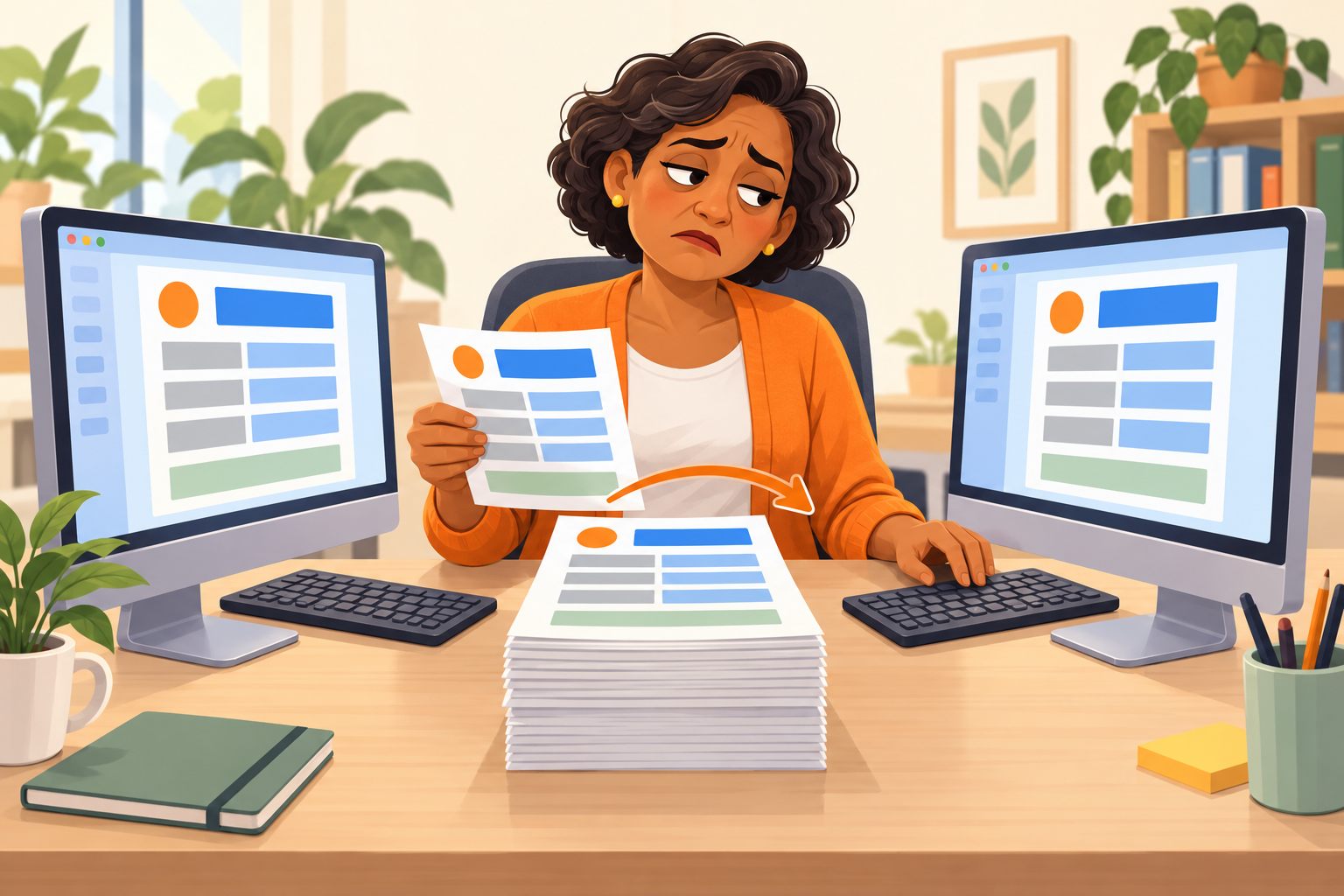
You're Paying to Type It Twice
By Domenic DiNatale
Somewhere in your company, right now, someone is typing the same information into a second system because the first one won't send it over. An order gets entered in the sales tool and re-entered in accounting. A customer's details get keyed into the CRM and again into the fulfillment system. A number from one report gets hand-copied into another. Nobody thinks of it as a problem. It's just "how we do it."
It's also one of the most expensive things in your business, and it hides perfectly, because it never appears as a cost. There's no invoice for "typing it twice." It's buried inside salaries you're already paying, spread across a dozen people doing a few minutes of it here and there, which is exactly why it survives for years without anyone deciding to fix it.
The Real Cost Isn't the Time
Add up the minutes and it's bad enough: a few people re-keying data for an hour a day is a full-time salary doing nothing but moving information the computers should be moving themselves. But the time is the cheap part. The expensive part is the errors.
Every manual re-entry is a fresh chance to get it wrong. A transposed number, a dropped line, a stale copy of a figure that changed in the source system an hour ago. Now your two systems disagree, and the real damage begins: not when the typo happens, but weeks later when someone makes a decision off the wrong number, or a customer gets billed for the wrong thing, and a senior person spends a day figuring out which system to believe.
That's the true tax of typing it twice: not the entry, but the reconciliation. The standing, low-grade distrust of your own data, because everyone knows the systems don't agree and nobody's quite sure which one is right.
How to Find Where It's Happening
You find double entry by following the manual work. Ask around, honestly, with no blame attached:
- Where do we type the same thing into more than one place? People know. They've just never been asked.
- Where do we export from one system and import into another? A CSV download followed by an upload is double entry wearing a trench coat.
- Which numbers do we reconcile, and how often? Routine reconciliation exists only because two systems that should agree don't, automatically.
- What breaks when someone forgets a step? If forgetting to copy data from A to B causes problems downstream, you've found a seam that should be automatic and isn't.
Each answer points at a seam: a place where two systems that should hand off to each other require a human to carry the data across by hand. Those seams are where your hours and your errors are hiding.
Why the Fix Usually Isn't Another App
Here's where businesses go wrong trying to solve this. They assume the problem is one of the systems, so they go shopping for a better one. But the systems are usually fine. The problem is the gap between them, and buying a third app often just adds a third place to type it.
The fix for double entry is almost always integration: making the systems you already own hand data to each other automatically, so it's entered once and flows everywhere it needs to go. That's unglamorous work, which is why vendors would rather sell you a shiny new platform than connect the two you have. But connecting what you already pay for is usually cheaper, faster, and far less disruptive than ripping out a working system to replace it with another one you'll also have to connect.
This is the same lesson underneath the spreadsheet that runs your business: the pain isn't a missing tool, it's a missing connection, and the manual work people do to bridge the gap is the symptom you follow back to the real problem.
Where AI Fits: Carefully
AI genuinely helps here, in a specific and bounded way. Mapping two systems to each other (figuring out that this field over here means the same thing as that field over there, across messy, inconsistently-named data) is exactly the kind of tedious pattern-matching a model does well and fast. It can also read the mess that accumulated during the years of hand-copying and propose how to clean it up.
But (and this matters) integration is one of those places where being wrong costs real money. If the mapping silently puts the shipping address in the billing field, you don't find out until customers do. So the rule holds: let AI draft the mapping, let a human verify it before it goes live. AI makes the fast part faster. It does not get to decide, unsupervised, that two fields are the same and start moving your customers' money based on that guess.
The Takeaway
Double data entry is expensive precisely because it's invisible: paid for in salaries you've already committed and errors you discover too late to trace. You won't find it in your budget. You'll find it by following the manual work: the re-typing, the export-then-import, the monthly reconciliation that exists only because two systems won't agree on their own.
The fix usually isn't a new app. It's connecting the ones you already have, so information is entered once and trusted everywhere. Let AI accelerate the mapping, keep a human on the verification, and stop paying good people to be the integration layer.
Finding and closing these seams is a lot of what we do. If your team is typing it twice, we can help you connect what you already own. More on the Intellitech blog.