Let It Draft. Never Let It Decide.
By Domenic DiNatale
If you take one rule away from everything written about AI in business this year, make it this one: let it draft, never let it decide.
It fits on a sticky note, which is the point. The hard part of using AI well in an actual company isn't the technology — it's knowing where the line is between work AI should do for you and work it should never be trusted to finish on its own. That line is the difference between an AI that quietly makes your team faster and an AI that quietly makes an expensive mistake nobody caught until the invoice, the contract, or the payroll run had already gone out.
Draft versus decide is how you find the line every time.
What "Draft" Actually Means
A draft is a starting point a human finishes. It's reversible. It's reviewable. If it's wrong, you catch it before it becomes real, and the cost of being wrong is a few minutes of editing.
AI is genuinely, immediately good at drafting, and most businesses are underusing it here. A capable model will:
- Turn a pile of documents into a first-draft answer, with the source passages pulled up so a person can check them.
- Write the first version of a proposal, an email, a job description, or a policy — in your voice, if you've shown it your voice — for a human to sharpen and approve.
- Read a mess (a spreadsheet, a stack of PDFs, a thread) and pull it into structured data you can actually work with.
- Produce the Monday "where does everything stand" summary by reading across the systems your team already lives in.
Notice what all of these have in common: a person is still in the loop, and the AI's output is an input to a human decision, not the decision itself. That's the safe, high-value zone, and it's broad. Most of the real productivity on offer right now lives here.
What "Decide" Means — and Why It's Different
A decision is an action the business takes as a result. It commits money, makes a promise, moves something that's hard to move back. When AI decides, there's no human between the model's output and the consequence — and that's where the trouble lives.
The problem isn't that AI is usually wrong. It's that it's wrong unpredictably, and confidently, in exactly the cases you didn't think to check. A model will price a job, approve a refund, or send a message with the same calm tone whether it's right or catastrophically off. It has no sense of which mistakes are survivable and which ones end a client relationship. That judgment — knowing which errors actually matter — is the thing you're paying a human for, and it's precisely the thing you give up when you let the AI close the loop.
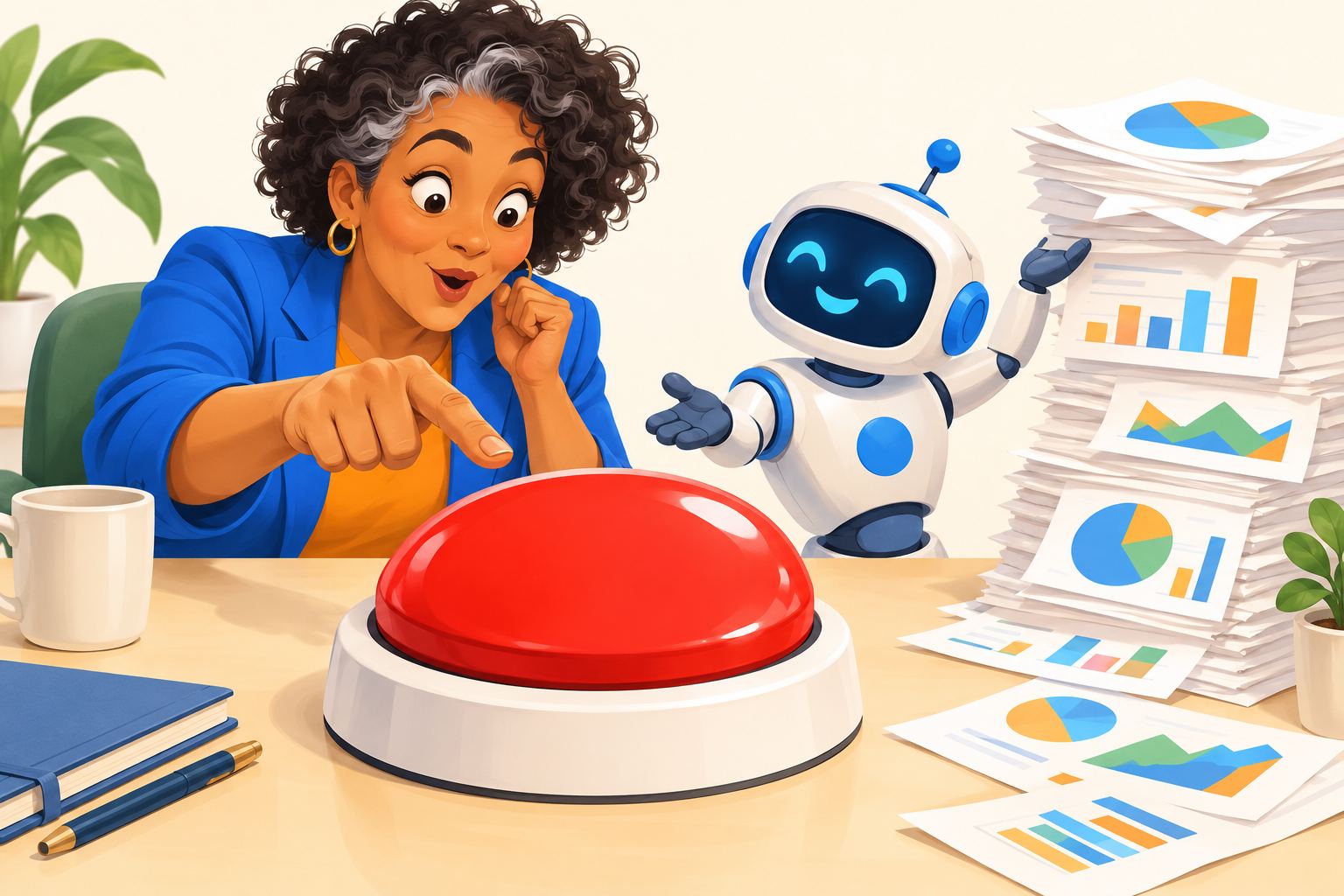
I've written before about building an AI operations layer with real access to real infrastructure. The single most important design decision in that whole system wasn't what the AI could do. It was where I forced a human to press the button — outbound email to clients, anything that sends. The AI drafts. I decide. The latency is the feature.
Ready Today vs. Not Yet
Here's the map I give clients. It isn't about how smart the AI is. It's about what being wrong costs, and whether a person is there to catch it.
Ready today — draft work, where a human reviews before it's real:
- First drafts of written material: proposals, emails, posts, policies.
- Document-to-answers: "what does our contract say about X," with citations to check.
- Pulling structure out of a mess: messy data into clean records.
- Cross-system status: "where does this job stand," "what slipped this week."
- Internal lookups and summaries that a person acts on.
Not yet — decision work, where being wrong costs real money with no human check:
- Anything that moves money, makes a payment, or commits a price without a person signing off.
- Anything that sends an external promise — a quote, a contract term, a client reply — unreviewed.
- Anything touching payroll, legal, or compliance without a human in the seat.
- Replacing the person who knows why the business does something a certain way.
The border between these two columns isn't fixed forever — as tooling matures and you build real guardrails, specific decisions can graduate from "not yet" to "ready," deliberately and one at a time. But the default, until you've earned the right to move an item, is that it lives in the left column.
How to Apply It This Week
You don't need a strategy deck. You need to run one honest test on anything you're thinking of handing to AI: if this is wrong and nobody catches it, what happens?
If the answer is "a person wastes a few minutes fixing a draft" — go, today. That's free productivity you're leaving on the table.
If the answer is "money moves, a promise goes out, or a number nobody can trace becomes real" — keep a human on the button. Not forever, necessarily, but until you've built the checks that would catch the failure, and you've decided, on purpose, that this specific decision is safe to delegate.
That's the whole discipline. It's the same instinct behind designing systems that fail well: assume the component will sometimes be wrong, and arrange things so that when it is, the damage is contained.
The Takeaway
AI doesn't fail because it's not capable enough. It fails because businesses point it at decisions before they've built anything to catch its mistakes — and then act surprised when a confident wrong answer becomes a real one.
Let it draft. Keep the speed, keep the leverage, keep a person in the seat where the consequences live. Never let it decide — until you've deliberately decided it's safe to, one decision at a time. That rule will keep you on the right side of almost every AI question you'll face this year.
We help companies put AI to work exactly this way — fast where it's safe, bounded where it isn't. If that's the conversation you want to have, let's talk. More on the Intellitech blog.