The Spreadsheet That Actually Runs Your Business
By Domenic DiNatale
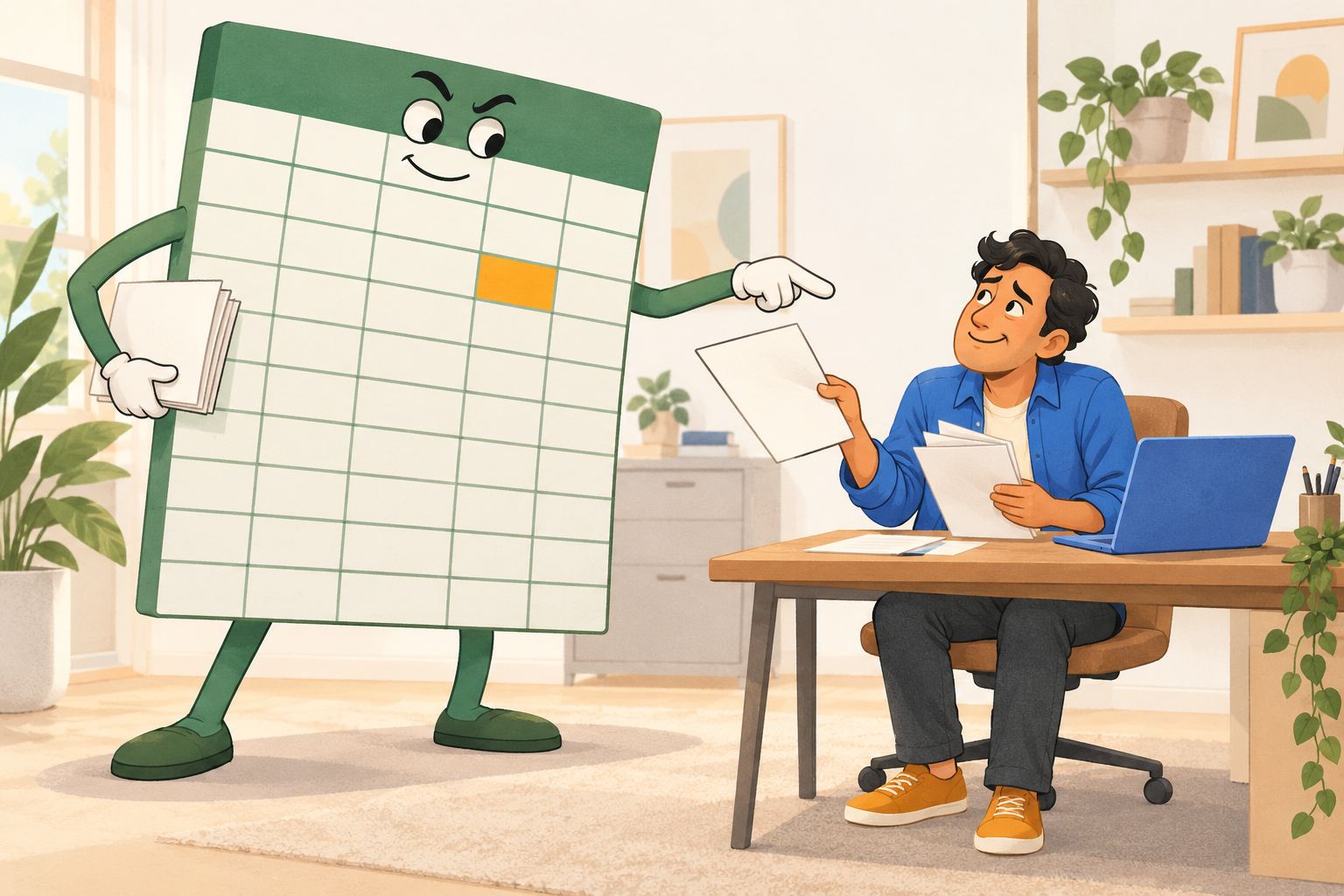
Every company I've walked into in thirty years of doing this has one. Sometimes it's a spreadsheet with a decade of formulas nobody has audited. Sometimes it's a little database a former employee built in a weekend. Sometimes it's a document, a shared drive full of macros, or a sequence of steps that lives entirely in one person's head. Whatever form it takes, it runs something the business genuinely cannot run without — scheduling, pricing, inventory, commissions, who gets paid what — and exactly one person actually understands how it works.
Here's the uncomfortable part: that tool usually works fine. That's why it's dangerous. Nothing is on fire. The reports come out on time. The owner sleeps. And because nothing is visibly broken, nobody ever decides to deal with it — right up until the person who understands it takes a new job, goes out on leave, or retires, and the business discovers that a load-bearing wall was being held up by one set of hands.
Why "It Works" Is the Problem
We're wired to fix things that are broken and leave alone things that aren't. For most of what you own, that instinct is correct. For the spreadsheet that runs your business, it's exactly backwards.
A tool like this accumulates risk quietly, in the gap between "it works" and "we understand why it works." Every time the one person who maintains it makes an undocumented change, that gap widens. Every year it survives, more of the business reshapes itself around its quirks, until the tool isn't modeling your operation — it is your operation. The spreadsheet stops being a tool you use and becomes a thing you depend on, in the specific sense I've written about before: a dependency you don't control and can't easily replace.
The failure, when it comes, is rarely dramatic. It's a Monday where a number is wrong and no one can say why. It's a quote that goes out underpriced because the formula that protected your margin lived in a cell someone copied over. It's three weeks of a senior person reverse-engineering a file they didn't write, while the work that file does for you simply doesn't happen.
How to Find Yours
You almost certainly have at least one. Finding it doesn't take a consultant or an audit. It takes a few honest questions, asked about every important thing your business does:
- If one specific person were out for a month, what would stop working? Not slow down — stop. Follow that answer to the tool behind it.
- What do we rebuild by hand, the same way, every week or every month? Recurring manual work is almost always a map to a system that doesn't quite exist yet.
- Where does a number come from that everyone trusts but no one can trace? Trusted-but-opaque is the signature of a tool that has outlived its documentation.
- What would a new hire be afraid to touch? If part of your operation comes with a verbal warning — "don't change that, only Dave knows how it works" — you've found it.
Write down what those questions surface. That list is a risk register you didn't know you had, ranked by how much of the business each item quietly carries.
Where AI Helps — and Where It Absolutely Doesn't
This is the part everyone wants to skip to, so let me be precise about it, because the honest answer is split down the middle.
AI is genuinely good at reading the thing and explaining it back. Point a capable model at a sprawling spreadsheet and it will document the formulas, surface the hidden logic, flag the circular references, and produce a plain-English description of what the file is actually doing — in an afternoon, not a month. That alone can turn "only Dave knows" into "it's written down." AI is also a strong first drafter of the replacement: it can propose a data model, sketch the rules, and generate a starting point far faster than a person with a blank screen.
What AI cannot do is tell you why. It can read that your pricing tool adds a mysterious 4% to one customer category. It cannot know that the 4% exists because of a handshake deal from 2019 that your business depends on and your biggest client assumes is permanent. That knowledge isn't in the file. It's in the person. And it is exactly the knowledge that determines whether the replacement is right or quietly catastrophic.
This is the rule we hand every client, and it holds here cleanly: let it draft, never let it decide. Use AI to read, document, and propose — fast. Keep a human who understands the business in the seat where the decisions get made. An AI that rewrites your commission logic without knowing why the logic is shaped that way doesn't remove your key-person risk. It automates it.
What Fixing It Actually Looks Like
You don't fix this by declaring a big replatforming project and disappearing for a year. You fix it by shrinking the gap between works and understood, in roughly this order:
- Document it while the person is still here. This is the cheapest insurance you will ever buy, and AI makes it nearly free. Get the logic out of the one head and into writing. Do this first, before anything else, because everything else depends on it.
- Decide what it's really worth. Some of these tools should become real software with a database, an audit trail, and more than one person who can run it. Some should just be documented and left alone. Not everything needs to be rebuilt — it needs to be understood, and then a deliberate choice made.
- Rebuild the load-bearing ones properly. When a tool carries enough of the business to justify it, replace it with something maintainable — designed so the next person can run it, and so a bad day is a contained annoyance instead of a crisis. That's the whole idea behind designing systems that fail well.
Most of our engagements start exactly here, with a short assessment that finds these tools and tells you which ones are worth money and which ones just need daylight. It's a small, low-risk way to find out how much of your business is being held up by one set of hands.
The Takeaway
The riskiest thing in your company usually isn't the thing that's broken. It's the thing that works perfectly and that only one person understands. It doesn't announce itself, it doesn't show up in a status meeting, and it gets more dangerous every year precisely because it keeps working.
Find yours before it finds you. Get it documented while the person who knows it is still in the building. Then decide, deliberately, which of these quiet tools deserve to become real systems — and let AI do the fast part while a human who knows why keeps the decisions.
If you suspect there's a spreadsheet running your business and you'd rather find out on your terms, that's exactly the kind of thing we look for. Read more on building and operating systems you can trust on the Intellitech blog.