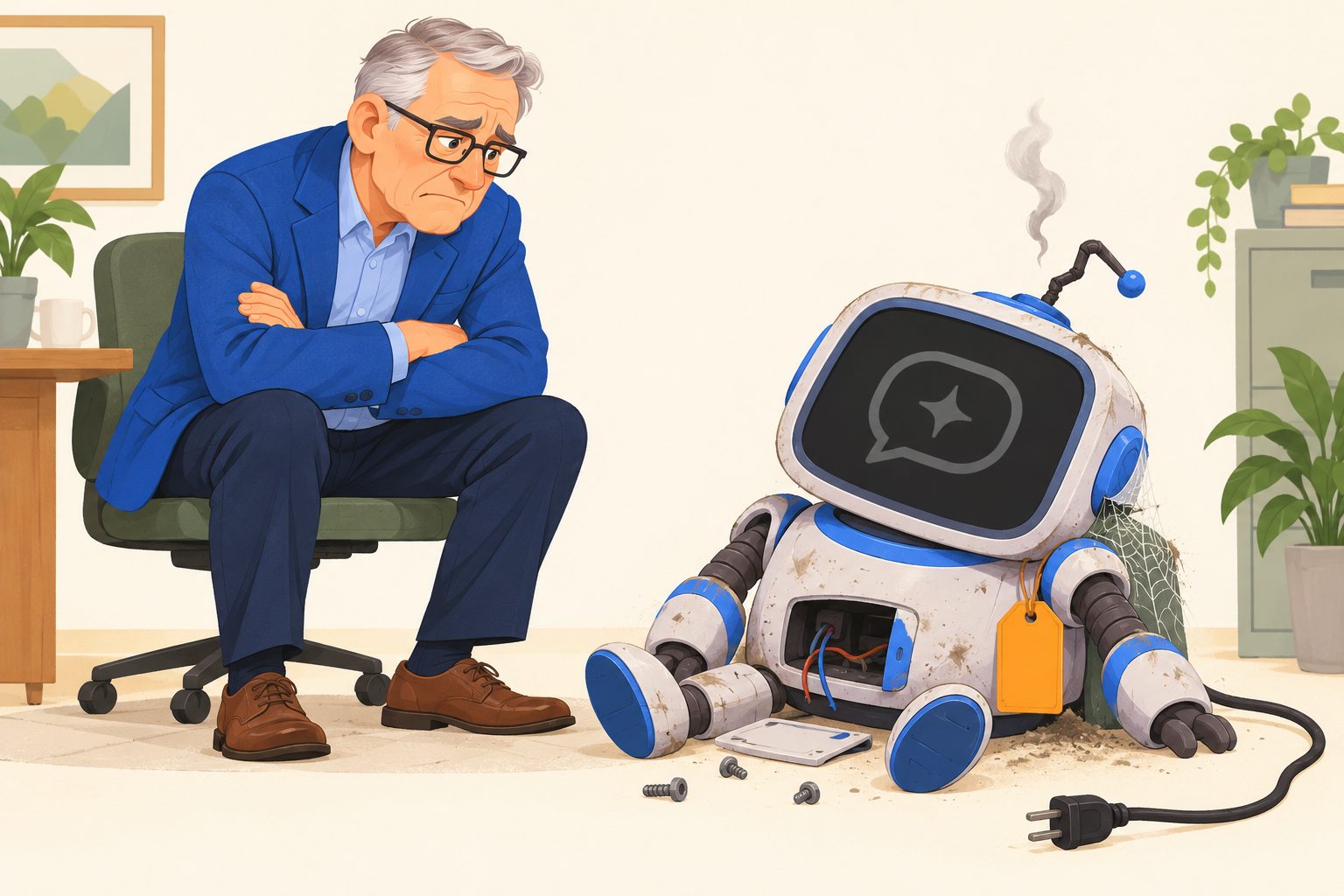
You Already Paid for an AI Project That Didn't Work. Here's Why.
By Domenic DiNatale
Here's a pattern I see constantly. A business owner tells me, a little sheepishly, that they "tried AI" last year. There was a vendor, a demo that looked genuinely exciting, a check that got written. And then... nothing. The thing never made it into how the company actually works. It wasn't a disaster, exactly. It just quietly didn't happen, and now the word "AI" carries a faint smell of money that didn't come back.
If that's you, I want to be clear about something: it probably wasn't your fault, and it almost certainly wasn't because AI "isn't ready." The capability was real. The demo wasn't lying. What killed the project is boring and predictable, and once you can see it, you can avoid paying for it twice.
Three things kill most AI projects. None of them is the AI.
1. It Ran on a Demo, Not on Your Data
The demo worked because it ran on clean, curated, cherry-picked data — the vendor's sample set, or a tidy slice of yours chosen to show well. Your business does not run on clean, curated data. It runs on a CRM with half the fields empty, three spreadsheets that disagree with each other, PDFs scanned sideways, and institutional knowledge that was never written down anywhere.
The gap between "works in the demo" and "works on Tuesday" is almost entirely this gap. An AI solution is only as good as the data it stands on, and most pilots quietly skip the unglamorous work of getting real data into real shape. So the demo dazzles, the rollout hits the actual mess, the results get flaky, trust evaporates, and the project dies — not because the model failed, but because it was never actually pointed at your business.
The fix: a project that's serious about shipping spends its first real effort on your data, not on the model. If a proposal doesn't mention where the data comes from, what state it's in, and who's cleaning it up, it's a demo plan, not a deployment plan.
2. Nobody Owned It
The demo had a champion — someone excited, usually the person who booked the meeting. What it didn't have was an owner: a person whose job it was to drive the thing into daily operations, change the workflows around it, and answer for whether it actually got used.
AI doesn't deploy itself into a company any more than a new hire onboards themselves. Somebody has to decide that the team will now do the thing the new way, handle the friction when people resist, and keep adjusting until it sticks. Pilots without that person produce a working tool that sits next to the old way of doing things — and the old way always wins, because it's what everyone already knows.
The fix: before you spend a dollar, name the owner and give them the authority to change how work gets done. If the only plan is "we'll roll it out and people will use it," you've already found your failure.
3. Nobody Decided What the AI Was Allowed to Do
This is the quiet one, and it's the one I care most about. Most dead pilots never made an explicit decision about where the AI's judgment ends and a human's begins. So one of two things happened. Either it was wired to decide things it had no business deciding, produced a confident wrong answer, burned someone, and got switched off in a hurry — or, more often, everyone was nervous about exactly that, so nobody trusted it with anything real, and it withered from disuse.
Both failures come from the same missing decision. I've argued the whole discipline fits on a sticky note: let it draft, never let it decide. A pilot that never draws that line either over-trusts the AI into a blow-up or under-trusts it into irrelevance. A pilot that draws it clearly — "the AI drafts these five things, a human approves before anything goes out" — gives people something they can actually adopt, because they know exactly what they're still responsible for.
The fix: decide, in writing, what the AI drafts and what a human still decides, before launch. That one decision does more for adoption than any amount of model sophistication.
What AI That Ships Looks Like
Put those three fixes together and the picture is almost unglamorous:
- It starts on your real data, and the first phase is largely about getting that data usable.
- It has a named owner with the authority to change how work actually gets done.
- It has a clear line between what the AI drafts and what a human decides.
- It targets one painful, repetitive, well-understood task first — not a moonshot — so there's a real win to build trust on before anything bigger.
That's it. No six-month discovery phase that produces a slide deck. No proof-of-concept that proves a concept nobody doubted. Production-grade AI, pointed at a real problem, with a human in the loop where it matters.
The Takeaway
If you paid for an AI project that didn't work, the odds are overwhelming that it died of one of three causes: it never touched your real data, nobody owned driving it into daily use, or nobody decided what it was allowed to do. All three are failures of how the project was run, not of what AI can do.
That's good news, actually. It means the next one doesn't have to go the same way — and it means the question to ask a prospective partner isn't "how smart is your AI." It's "whose data, whose job, and what's it allowed to decide." If they have crisp answers, you're looking at something that ships. If they only have a demo, you already know how that ends.
We build AI that makes it into daily use — on your data, with a human where it counts. If you've got a dead pilot and don't want a second one, let's talk. More on the Intellitech blog.