Introducing Keepacy: The Quiet System That Finds Your Family When It Matters
By Domenic DiNatale
I've been writing software for almost thirty years. My family knows what I do. They do not, however, know with certainty where my will is or how to get a hold of my lawyer. They don't know which insurance policy is which. They wouldn't be able to find the combination to the safe, or the video message I keep meaning to do for each of my children.
That's not a planning failure. I've done the planning. It's a findability failure — and it turns out almost everybody has it.
Keepacy is the product we built to fix that. It's a secure vault for the things your family would actually need if something happened to you, paired with a quiet check-in mechanism that delivers everything to the right people if you stop responding. They don't have to know to come looking. Keepacy finds them.
What Keepacy Actually Does
At its core, the product solves three problems that estate planning, password managers, and shared cloud drives each solve a piece of, but none solve together.
Storage. Documents, account information, attorney and accountant contacts, safe combinations, medical directives, personal letters, video messages — anything you can think of that someone would need to find, all in one encrypted place.
Routing. You decide who gets what. Your spouse can have access to everything. Your business partner can have the operating agreements and the server keys, and nothing else. Your kids can have the personal letters when they're old enough.
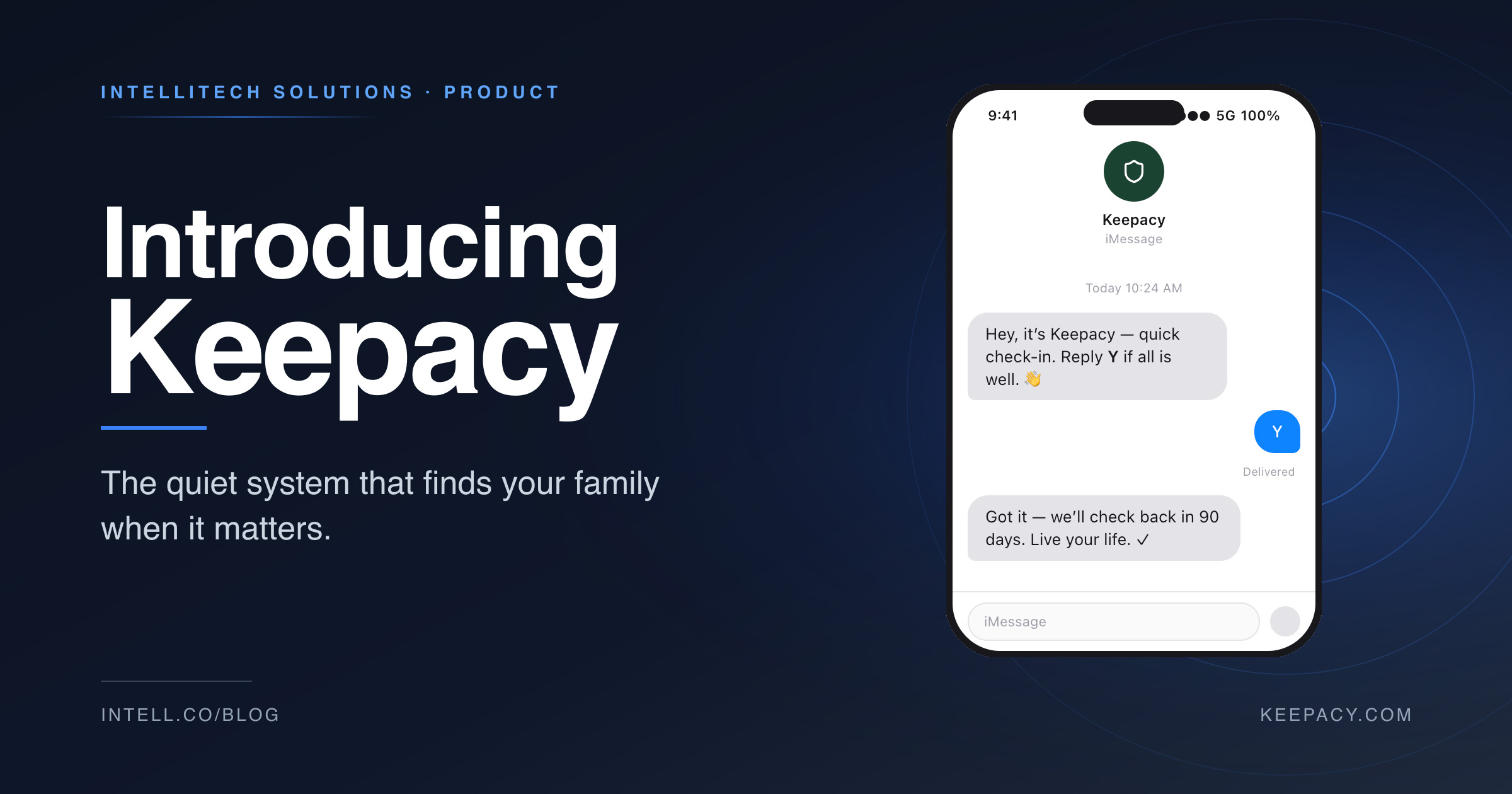
Delivery. This is the part most products skip. Keepacy periodically checks in with you. As long as you respond, the vault stays locked. If you stop responding for long enough, after a series of escalating nudges, it reaches out to the people you designated and gives them what you set aside for them.
That last part is the difference between a vault and a system. A vault waits. A system acts.
The Technical Part — For The People Who Like That Sort Of Thing
The piece that took the most thought was the check-in mechanism, because it's the thing that has to work perfectly when no one is paying attention.
We started by ruling out the obvious naive design: a single timer that fires after some long interval. That has two problems. It's brittle — one missed email and your family gets a panic notification while you're on vacation. And it's slow — if something does happen, your family waits weeks or months before anything reaches them. Neither of those is acceptable.
What we built instead is a multi-stage protocol with adjustable cadence. The system reaches out on a schedule you control — daily, weekly, monthly, whatever fits your life. A response resets the clock. No response triggers a graduated escalation: more frequent check-ins, alternate channels, reminders to people you've designated as a soft second line. Only after that whole sequence completes without a response does the vault begin its release process. By the time delivery happens, the system has tried very hard to be wrong about you.
Underneath that, the architecture is what you'd expect from an Intellitech product. Java and Spring Boot on the API layer, because that's where we have the most operational confidence and the most reusable infrastructure from twenty-plus years of building consultancy work in the same stack. React on the front end. AWS for hosting, with encrypted storage at rest and per-recipient key derivation so that even we can't read what you put in your vault. Audit logging on every state change, because in a product like this, "we don't know what happened" is never an acceptable answer.
The other piece worth mentioning is identity. A system that delivers sensitive material to people you've named has to be very, very sure it's delivering to the right person. We use multi-factor verification on the recipient side, with fallback paths for the realistic case where someone's phone or email has changed in the years between when you set Keepacy up and when it actually needs to do its job. That's a problem most software gets to ignore. We don't.
Why This Is A Product And Not A Feature
People sometimes ask why this couldn't just be a folder in a password manager, or a clause in a will, or a note to a trusted friend. The honest answer is that those things technically can do parts of what Keepacy does. But none of them do the part that matters most: they don't reach out. They wait to be found. And in the moments where Keepacy is meant to be useful, the people who need the information are not in any condition to be running searches and remembering passwords.
Building software that goes looking for the right person, on its own, on a timeline measured in years rather than minutes, is a different kind of engineering problem. It's not harder, exactly. It's just unfamiliar to most of the patterns we use day to day. Most of what we build assumes a user who is present. Keepacy assumes a user who isn't.
Where This Fits, And Where It Might Go
For now, Keepacy lives under the Intellitech umbrella. It's a product we built, not a separate company, and the team that built it is the same team that's been doing transportation systems and broadcast platforms and healthcare integrations for nearly three decades. That continuity matters: this isn't a side project we're winging. It's a real product, built the way we build for clients, by people who've shipped software for a long time.
If it scales the way I think it can, Keepacy will eventually stand on its own. For now, the most important thing is that it exists, that it works, and that the people who need it can find it.
It's free to start. It takes about ten minutes to set up. And if you're anything like me — if you've done the planning and still know, in the back of your mind, that your family would be searching drawers — it's probably the most useful ten minutes you'll spend this week.
Learn more at keepacy.com.